Why an AI trading indicator should explain, not signal
Most traders who try an AI trading indicator want one thing: an arrow that says buy or sell. The trouble is that an arrow gives you nothing to check. When it fails, you do not know whether the idea was wrong or your timing was. You learn nothing, and you start trusting or distrusting the tool on feel.
Mirra AI is built the other way round. The indicator first computes the structure — the Market Profile, the Order Flow footprint, the Open Interest, the Elliott Wave count — and then the AI reads that structure back to you. It tells you who is in control, what to do, and what would prove it wrong. In plain words, at the level you trade at.
We covered the general question of what AI can and cannot read from a chart in AI Trading Tools in 2026. This post goes one level deeper: how the five voices of the Mirra AI panel work, how one market situation sounds in each of them, and which voice to use at which point in your day.
One engine, five voices
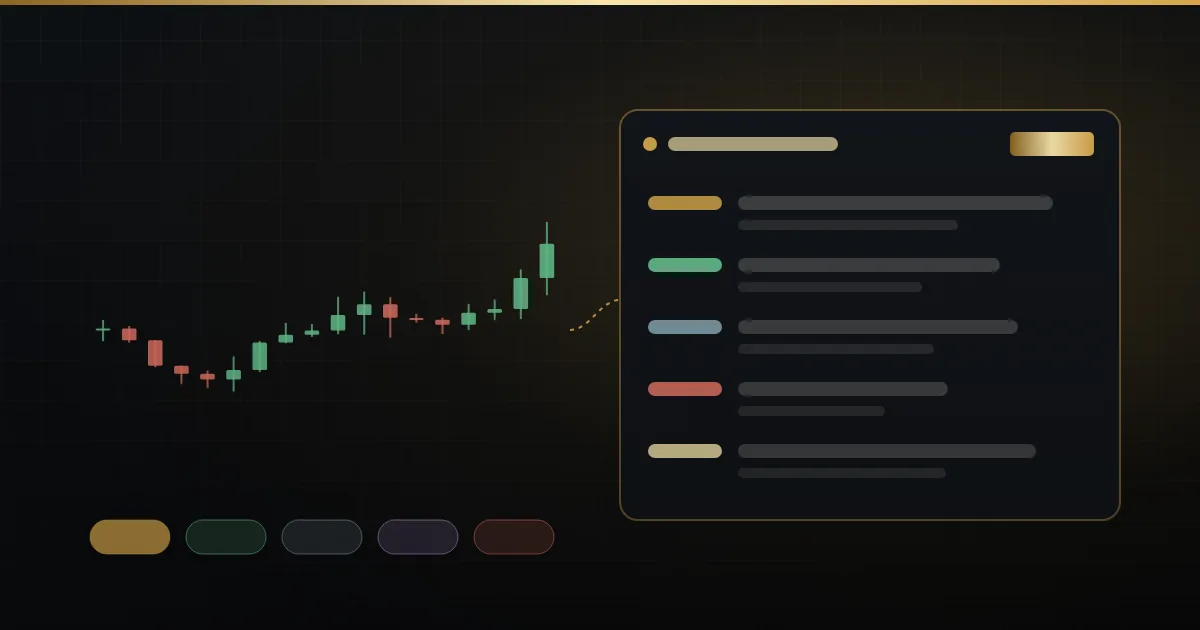
The AI panel sits on the left of the chart and has five modes: Simple, Beginner, Coach, Debate and Pro. They are not five different opinions. They are five ways of explaining the same conclusion.
- Simple — one badge, one action, one invalidation. Nothing else on screen.
- Beginner — the same call, plus the evidence behind it, in words.
- Coach — teaches the auction, and says WAIT — NO TRADE when that is the answer.
- Debate — the bull case and the bear case, each point weighted, then a verdict and the flip level (the price where the verdict changes sides).
- Pro — everything, in the language of the trading desk. On Market Profile that includes things like the 80% rule risk (the auction tendency for price that re-enters the prior day’s value area and holds there to travel across it) and the initial balance extension targets.
The Elliott Wave panel follows the same pattern for wave counts. There, Pro adds confidence, the primary versus alternate count, the higher timeframe, the Profit-Taking Index, Open Interest and memory, while Coach gives step-by-step orders when a setup is ready and reminds you that “patience is a position” when it is not.
| Mode | What you see | Best for | Typical moment |
|---|---|---|---|
| Simple | One badge, one action, one invalidation | Quick glance while managing a trade | Mid-session, positions open |
| Beginner | The call plus the evidence, in words | Traders learning what the chart shows | Before the first trade of the day |
| Coach | A lesson on the auction; says WAIT when there is no trade | Building discipline, avoiding forced trades | Choppy, overlapping sessions |
| Debate | Bull vs bear, weighted points, verdict and flip level | Checking your own bias | When you already “know” the direction |
| Pro | Full read in desk language | Experienced traders who want every input | Pre-market plan and post-session review |
What the AI actually reads
An AI read is only as good as its inputs. Mirra AI does not look at a candle and guess. It reads what the indicators have already measured, which is structure the market actually left behind.
Structure: where value lives
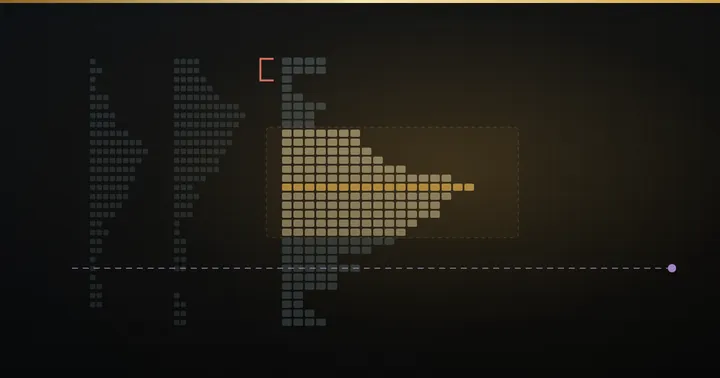
From the Market Profile & TPO, the AI reads the value area (the price band where most trading happened), the POC (point of control, the busiest price), the day type, the initial balance (the first hour’s range) and its ×1.5 / ×2 / ×3 extensions, plus poor highs, poor lows and single prints — signs of an unfinished or one-way auction.
Order flow: who is pushing, and who is absorbing
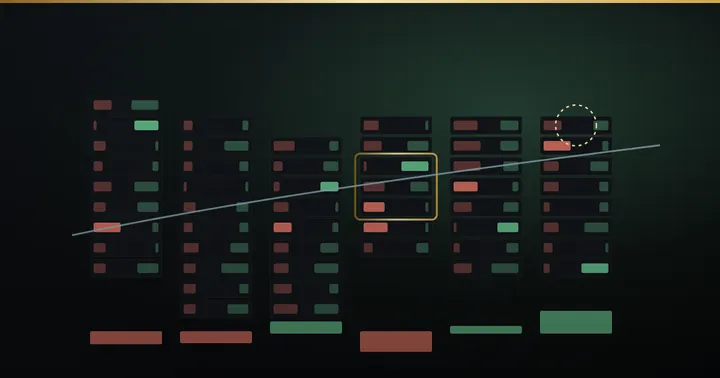
From the Order Flow footprint, it reads delta (aggressive buying minus aggressive selling), cumulative delta, stacked imbalances, absorption (heavy aggression that fails to move price), exhaustion and trapped traders. On the footprint, the panel rebuilds on live ticks every few seconds, not only when the bar closes.
Positioning: is money arriving or leaving?
Open Interest (OI) is the count of open futures or options contracts. Price against OI change gives four states: long buildup (price up, OI up), short buildup (price down, OI up), short covering (price up, OI down) and long unwinding (price down, OI down). A rally on short covering is not new buying — it is shorts leaving, and it can run out of fuel. The OI features need an Accelpix Pix Connect feed. Our guide on reading OI on Nifty and Bank Nifty intraday covers the four states in depth.
The AI’s job is to put these three layers into one sentence that agrees with itself — and to say plainly when they do not agree.
One Nifty morning, five ways to say it
Here is one market situation, followed by how each mode would phrase it. The prices and wording below are illustrative, written for this article to show the difference in style. They are not a recorded panel output and not a trade recommendation.
Say Nifty futures open at 24,180 IST 9:15. In the first hour price climbs and pokes above yesterday’s high of 24,260, reaching 24,290. The footprint shows positive delta, but at 24,280–24,290 heavy buying is being absorbed and price will not lift. The profile marks the high as a poor high (no tail, an unfinished auction). OI is falling while price rises — short covering, not fresh longs. Yesterday’s value area high sits at 24,230.
Simple
“Lean: cautious. Action: no new long here. Wrong if: Nifty holds above 24,300.”
Beginner
“Price broke yesterday’s high, but the move looks weak. Buyers are hitting the offer and price is not moving, which means a seller is soaking it up. Open Interest is falling, so this is shorts closing, not new buyers. A return to 24,230 is the more likely path. This idea is wrong if price holds above 24,300 with OI rising.”
Coach
“This is a classic test of yesterday’s high. A breakout needs new money; this one is running on short covering. WAIT — NO TRADE. Do not chase the high. Watch for either acceptance above 24,300 or a move back inside value below 24,230. Let the market show you which.”
Debate
“Bull: higher high, positive delta, opened above value. Bear: absorption at 24,285, poor high, rally on falling OI. Verdict: bear case slightly stronger, kept moderate, not certain. Flip level: 24,300 — acceptance above it hands the case to the bulls.”
Pro
“Look above and fail risk at prior-day high. Initiative buying absorbed at 24,280–24,290; poor high unfinished. Delta × ΔOI classifies the leg as short covering. Re-entry into prior value below 24,230 brings the 80% rule into play toward the opposite side of value. Invalidation: 30-minute acceptance above 24,300 with fresh long buildup.”
Mirra Memory: odds tempered by history
Any read that quotes a probability raises a fair question: based on what? Mirra answers that with memory rather than textbook numbers.
- Market Profile remembers comparable sessions and shows a hit rate, the sample size and an odds multiplier, so day odds are tempered by history instead of asserted from thin air. Its Stance line compares today’s open, trend and volatility with this instrument’s own history, with the sample count shown.
- Buy / Sell Readiness is a score from 12 to 88 combining trend, momentum, OI conviction and value, with its three strongest reasons and the nearest level that proves it wrong.
- Mirra Edge on the footprint makes a 30-minute call from the last three bars — direction, probability, size and invalidation — then grades it, with the hit rate printed on the line.
- Mirra Memory on the Elliott Wave logs every completed wave and setup outcome per instrument, so the panel quotes real hit rates on your instrument.
Probabilities are also clamped. Wave confidence is held between 12% and 88%, setup probabilities between 15% and 85%, and Debate splits are bounded. No panel is allowed to imply certainty. That is deliberate: a market that can be read is not a market that can be predicted.
What would prove it wrong — and why that is the point
Every Mirra AI read names its own invalidation: the level or condition that, if it happens, means the read is wrong. A read without one is an opinion. With one, it becomes a plan you can size and manage.
In the Nifty example, the cautious read is wrong if price is accepted above 24,300 — meaning it holds there and builds value, not just a single spike. It is more convincingly wrong if OI starts rising on that move, because rising OI with rising price is long buildup: fresh money committing. If delta stays positive and the absorption at 24,285 gets eaten through, the seller has been overwhelmed. Any of these tell you to drop the cautious view, not argue with it.
This is why Mirra calls its AI decision support, not signals. The panel ends with “decision support only, not advice”. It does not place trades. It reads faster and more consistently than you can across profile, flow and OI, and then it hands the decision back to you, along with the price where you should change your mind.
Which mode to use when: a daily routine
You do not need all five voices at once. Here is a simple routine for an NSE session using NinjaTrader 8 and Accelpix data.
- Pre-market (before 9:15 IST) — Pro. Read the full picture on yesterday’s profile: value area, naked POCs, day type, OI buildup. Write down two levels and what would change your bias.
- Shortlist — the scanners. Use the Market Profile Scanner or Order Flow Scanner to find the two or three F&O stocks or indices worth a chart. Our scanner watchlist guide shows how.
- First hour — Coach. The initial balance is still forming. Let the Coach tell you when the answer is WAIT, and do not force a trade before the auction shows its hand.
- Before entry — Debate. When you feel sure of a direction, switch to Debate. If the other side’s points carry real weight, reduce size or wait. Note the flip level.
- In a trade — Simple. One badge, one action, one invalidation. Less to read means fewer emotional decisions while the position is live.
- Learning days — Beginner. If you are new to Market Profile or footprints, keep Beginner on for a few weeks so every call arrives with its evidence.
- After the close — Pro again. Compare what the panel said with what happened, and check the hit rates and sample sizes from memory.
To see the panel live, join the free weekly webinars, where the team walks through Mirra AI on real NinjaTrader charts, or start with the free 5-day trial from the downloads page. Plans and licences are on the pricing page.
Frequently asked
Is Mirra AI a buy/sell signal generator?
No. It is decision support only. It explains what the profile, footprint and Open Interest show, names the level that would prove the read wrong, and leaves every trading decision to you.
Do the five modes give different answers?
No. Simple, Beginner, Coach, Debate and Pro explain the same conclusion from the same engine. Changing the mode changes the language and depth, never the answer.
Which Mirra AI mode is best for a beginner trading Nifty?
Start with Beginner, which gives the call plus the evidence in words, and use Coach in choppy sessions because it says WAIT — NO TRADE when there is no trade worth taking.
Can the AI predict where Nifty will go?
No tool can do that reliably. Mirra AI reads current conditions and tempers its odds with history; probabilities are clamped and every read names its own invalidation.
Does Mirra AI need Accelpix data?
Mirra runs on NinjaTrader 8. The Open Interest features need an Accelpix Pix Connect feed, which is what lets the AI tell fresh positioning from short covering.
Educational content only — not investment advice. Examples are illustrative. Trading in securities, derivatives, crypto and forex involves substantial risk of loss.